
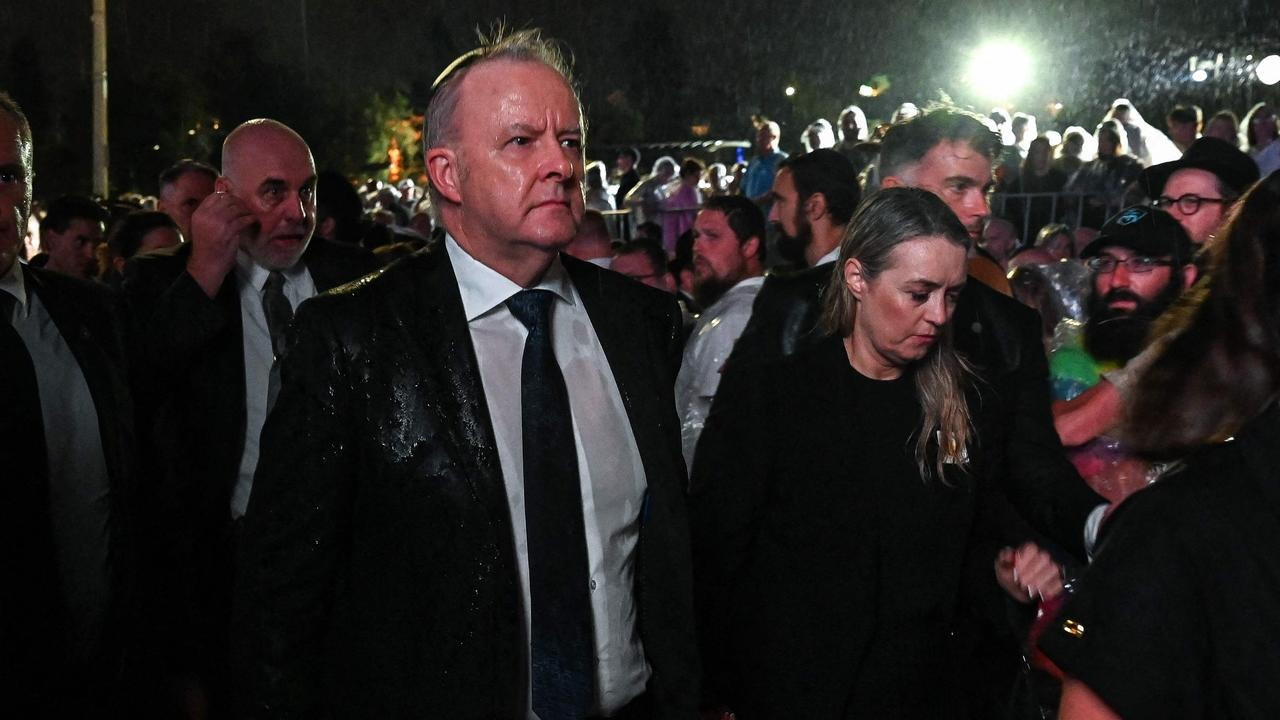
Prime Minister Anthony Albanese was dramatically chased out of Berat, Victoria, moments ago by an enraged convoy of farmers driving tractors and utes.
Fueled by anger over soaring electricity prices, emergency service levies, and forced renewable projects, this raw rural revolt marks a catastrophic blow to Albanese’s hold on regional Australia.
The scene that unfolded along the Midland Highway was nothing short of a political thriller. Albanese’s motorcade, sirens wailing, attempted to escape the relentless pursuit of dozens of tractors, trucks, and utes manned by farmers deeply frustrated with government policies.
This was no mere protest—this was an outright rejection of Labour’s regional strategy in visceral, unmistakable terms.
Farmers, the backbone of Australia’s food production, expressed their fury at the government’s renewable energy plans, which they claim are industrializing their farmlands without consultation or compensation. The protest highlighted their outrage at soaring emergency services levies, despite voluntarily providing those services, which many perceive as an unjust financial burden.
Inside the Bush Summit, the mood was equally charged. Albanese faced fierce heckling when attempting to defend the government’s renewable energy rollout.
His assertions that “the market” decided against coal power stations were met with loud jeers, with farmers accusing him of masking government-driven policies under the guise of market forces.
National Senator Bridget McKenzie’s entrance on a tractor, carrying a sign condemning “Labor’s towers,” perfectly encapsulated the raw tension. Her pointed critique of the federal government’s treatment of regional communities framed the political crisis: rural Australians feel marginalized, their voices drowned out by urban-centric agendas.
The protest signs—blunt and unapologetic—spelled out rural Australia’s uncompromising demands: stop the emergency services levies, halt farmland industrialization for renewable infrastructure, and respect farmers as vital contributors rather than cash cows. The anger was palpable, rejection unequivocal.
Albanese’s presence inside the summit, far from pacifying dissent, only underscored his disconnect. His insistence on engagement rang hollow amid a community screaming for genuine respect and acknowledgement of their legitimate concerns. The response was unambiguous: rural Australians want policy changes, not political platitudes.
Public speaking course
 This episode reveals deep fractures within Labor’s approach to regional Australia. Attempts to push aggressive climate policies without adequate regional consultation have ignited fierce backlash. The prime minister’s motorcade fleeing a convoy of angry farmers is a potent symbol of political alienation and the tangible cost of ignoring rural voices.
The moot calls for a federal Royal Commission into the Bondi tragedy overshadowed this unfolding regional crisis. As families continue to demand accountability and resignations, the prime minister faces compounding challenges from both national tragedy and regional uprising, 𝓉𝒽𝓇𝑒𝒶𝓉𝑒𝓃𝒾𝓃𝑔 his political capital on multiple fronts.
Opposition leader Susan Lee’s push to immediately reconvene Parliament to address anti-Semitism contrasts sharply with Albanese’s handling of both tragedy and regional fury. Critics argue his leadership lacks the urgency and seriousness required for these crises, further fueling calls for his resignation.
The tractor chase also crystallizes broader tensions around Australia’s energy transition, exposing cracks between environmental ambitions and on-the-ground realities. Farmers bear the dual brunt of escalating prices and industrial-scale renewable infrastructure disrupting their livelihoods and landscapes.
Within this charged atmosphere, emergency services volunteers, including CFA members, protested the unfair levy imposed on their selfless work. Their presence added another layer of protest to a summit dominated by frustration with government taxation and policy priorities.
Albanese’s response to hecklers inside the summit attempted to portray respect and engagement, yet fell flat against palpable public mistrust. His dismissal of nuclear energy as futuristic, while relying on unproven renewable technologies, fueled accusations of hypocrisy and political spin.
 This orchestrated rural rebellion is a dramatic warning signal for the Albanese government. Losing regional voters—who constitute roughly 40% of the population—threatens Labor’s electoral prospects and underscores the political cost of neglecting communities vital to Australia’s economy and democracy.
The performances on display—both the tractor convoy and summit heckling—expose a government struggling to reconcile green ambitions with regional realities. The prime minister’s flight from a hostile crowd encapsulates the palpable discontent simmering beyond urban centers.
The tractor chase is not just a spectacle but a defining moment in Australian politics. It captures raw resentment towards perceived governmental overreach and the sense that regional Australians are fighting against imposed policies that threaten their homes and futures.
This moment demands urgent reflection from federal leadership. Concessions, honest dialogue, and revised policy approaches are imperative to rebuild trust and avoid further alienating the vital rural electorate, whose support has rapidly eroded.
Amid escalating pressure, calls for Albanese’s resignation gain momentum. The prime minister now confronts a compounded crisis of political legitimacy, balancing national tragedy fallout with a regional revolt that has 𝓮𝔁𝓹𝓸𝓼𝓮𝓭 profound governance failures.
As videos circulate widely, capturing this unprecedented chase, the optics could hardly be worse: a leader literally driven from a town by outraged citizens, scrambling to retain relevance amid growing backlash on multiple fronts.
 The unfolding events mark a critical juncture in Australian politics. The government’s approach to renewable energy, emergency services funding, and broader rural engagement will be scrutinized as never before, with Albanese’s leadership hanging in the balance.
For now, the message from regional Australia is crystal clear—business as usual will no longer suffice. The prime minister must face this crisis head-on or risk complete political collapse as disenfranchised communities demand real change, accountability, and respect.
This breach between metropolitan policy and rural reality transcends simple political disputes. It represents a fundamental breakthrough point, signaling that the government’s current strategy is untenable and fostering intense grassroots resistance nationwide.
The tractor convoy pursuit is a bold manifestation of this dissent, blending symbolic defiance with tangible outrage. Its message to Canberra pulsates with urgency: listen to rural Australia or be prepared for ongoing upheaval and erosion of political mandate.
As the prime minister retreats under sirens, the symbolic weight of the 𝒹𝓇𝒶𝓂𝒶 reverberates across the nation, spotlighting deep divisions and a crisis of confidence in federal leadership at the most critical time.
This saga unfolds as a stark reminder that rural communities remain a powerful political force. Ignoring their voices risks not only policy failures but also destabilizing the very fabric of Australia’s democratic system.
With voters mobilizing and protests intensifying, the government faces a pivotal choice: adapt or confront an emboldened opposition determined to capitalize on Labor’s unraveling ties to regional Australia.
 The protest and its fallout inject new urgency into debates over energy policy, rural funding, and emergency services. Swift government action is critical to repairing strained relationships and restoring faith in political representation.
The events in Berat serve as a clarion call to all policymakers: the path to sustainable progress demands inclusive consultations, respect for regional stakeholders, and transparent, equitable solutions that bridge divides rather than deepen them.
As the story develops, the nation watches closely. Albania’s political fate now hangs in a tense balance as the prime minister grapples with a dramatic rural backlash and an impassioned demand for leadership accountability in turbulent times.